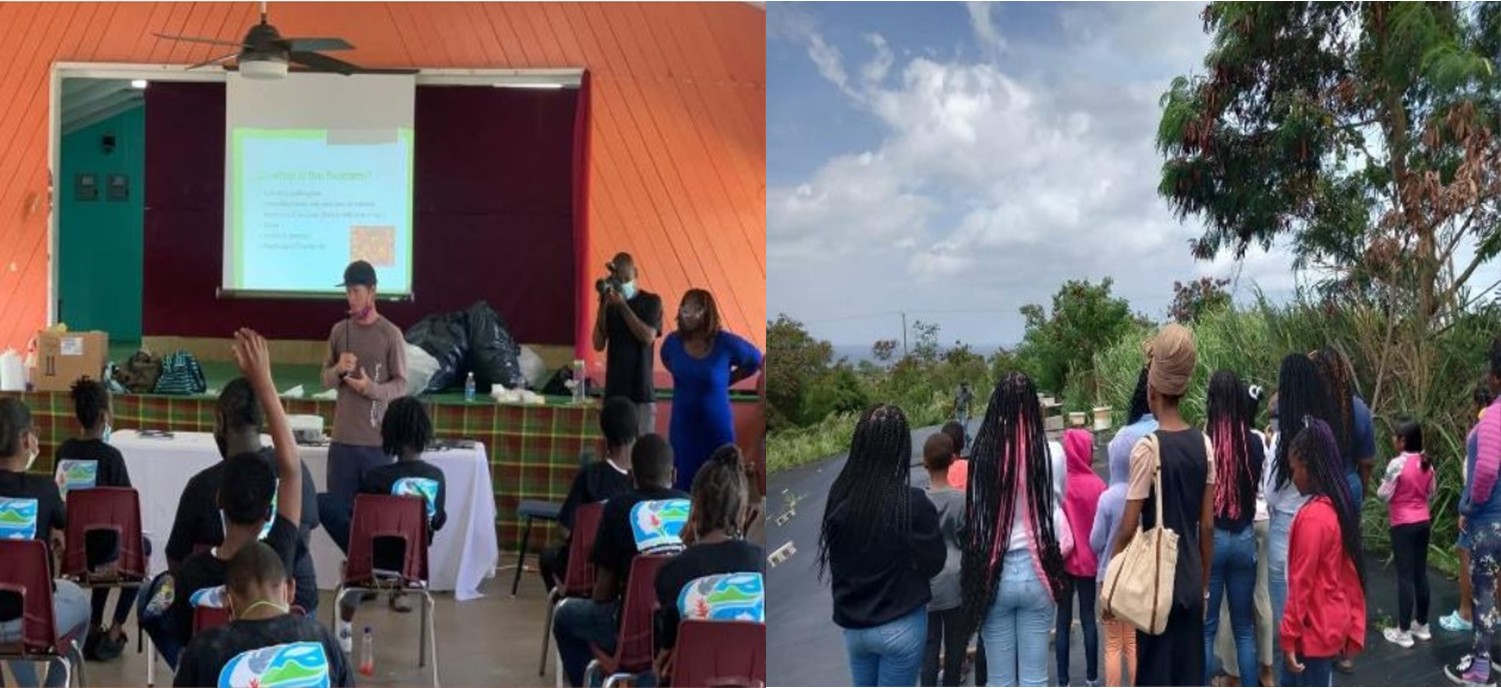
 Member Nicholas Dupre leading an educational session (l) and Kennedy ‘Natural’ Hazelle with a group at the national bee nursery.
 KEEPING IT IN THE FAMILY: Beekeepers carry over their interests to the next generation
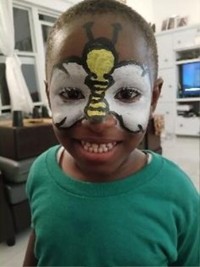
Amaru ‘Kingman’ Stevens has been coming to hive box-building workshops since he was 1 year old.
While there is increasing public awareness about the importance of bees to our planet, bees on the whole, continue to need their own Public Relations Officer!
The St Kitts Beekeepers’ Co-op is in the process of opening the first honey farm in the English-speaking Leeward Islands. In a recent survey carried out in the marketing process, they found that although 80% of those interviewed were aware of the overall benefits of bees to their environment and health, 25% of respondents expressed an insurmountable fear of bees that they felt would keep them away from visiting the honey farm. On the other hand, a third of the members of the Co-op have encouraged their children and grandchildren to enjoy beekeeping.
Take George Rogers – the Immediate Past President of the Co-op – at the age of 74 years, he has seen a lot of bees! Mr Rogers has himself, been involved with beekeeping since he was 12 years of age:
“It was a friend of the family nicknamed ‘Boysie Laplass’ that brought me into it…”
Mr Rogers reminisced that he saw beekeeping as an exciting adventure as a youngster. Two generations later, he is still active in beekeeping in St Kitts. He introduced his son, Calvert and his daughter Ros, to beekeeping. Almost like history repeating itself, he also introduced a younger friend of the family – Kevin Bowry – to the hobby. Mr Rogers explained that Kevin and he were two of the founders of the Co-op in 2001
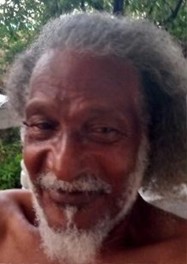
George Rogers (aged 74 years) was the President of the Co-op, and after 62 years, he continues to support beekeeping as the Immediate Past President.
Part of his legacy, is the introduction of Perone Hives to the island under his leadership. Perone Hives are tiered, hexagonal boxes that imitate a tree trunk, which is the most ‘natural’ home to a bee colony.
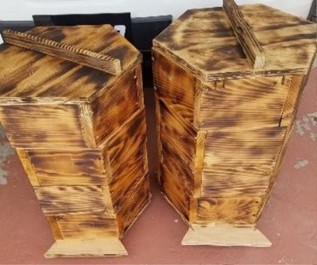
A pair of Perone Hives produced by the Co-op.
Hive box-building is a skill that specifically attracted Abrian ‘Snagga’ Stevens to the Co-op. In the past, both the price and the process of importing hive boxes to our tiny island was prohibitive. Consequently, hives were built using local lumber. Snagga – a certified joiner – found a renewed sense of satisfaction of building homes for bees and not just for humans!
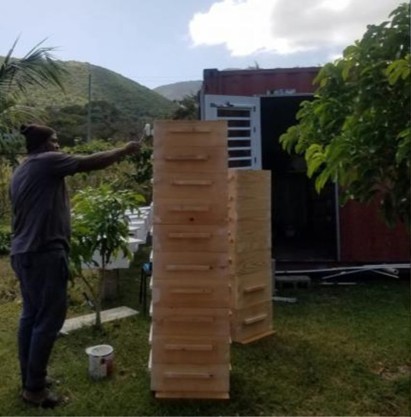
Abrian ‘Snagga’ Stevens assisting with painting a stack of hive boxes at a Co-op workshop.
Like Mr Rogers, Snagga takes his responsibility of being an active father seriously, and practically since he has been able to stand unsupported, his son Amaru ‘Kingman’ has been a regular participant in the Co-op’s hive box-building and frame assembling workshops.
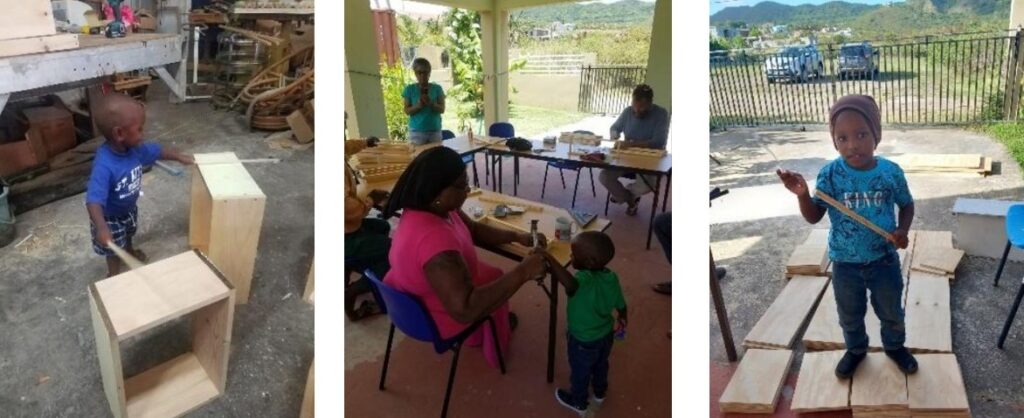
Kingman at Co-op workshops various stages of his development.
Snagga is eager to see the plans for the honey farm come to fruition:
“It’s for him that I see that it’s gonna be good, Know what I’m saying?”
The development of the next generation was formerly the bread and butter of the Co-op’s interim Secretary, Jeune Guishard-Pine. She has been working with children since 1981. The retired mother of six explained that it was a chance visit to a honey farm in Wales, UK that inspired her to become involved in beekeeping.
“Every summer, I would take my children on holiday to a different part of the UK, and when I saw that observation hive, that was it! I was completely obsessed with bees. I knew that that was something I wanted to do when I retire.”
Although she confesses that she is not a big user of honey herself, she was inspired by the tearoom and other merchandise on sale in the farm shop. Two of her daughters – Janae and Taiyo – ARE fans of honey and also joined the Co-op. As well as having their own hive, and joining hive inspections in their ‘Ayshea’ (women-only) apiary, they have been hugely involved in the administration and fundraising activities of the Co-op.
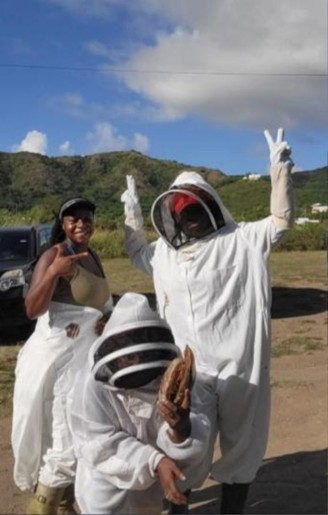
Taiyo (l.) is the Interim Treasurer of the Co-op and Janae (r ) is active in executing fundraisers for the Co-op, and Jeune crouching in the front following their first hive inspection together in the Ayshea apiary.
It is typical nowadays for children to wear a beesuit when they are in an apiary. Mr Rogers described in some detail how it was approached over 62 years ago when he first became involved in beekeeping as a child:
“We used to use a flour bag with a wire as a makeshift veil….there weren’t any apiaries then….it was all (dealing with) feral hives then and we used to cut them down and then carry them and store them in a sugar mill still in the trunk…”
Ironically, that method has recently re-emerged as a practice from Ancient China. The beekeepers cut a section of a felled tree trunk, cut a cover out of it, then drill out the core, make small entrances around the rim of the trunk, scorch it, line with melted beeswax and the place in a location as a swarm trap.1,2
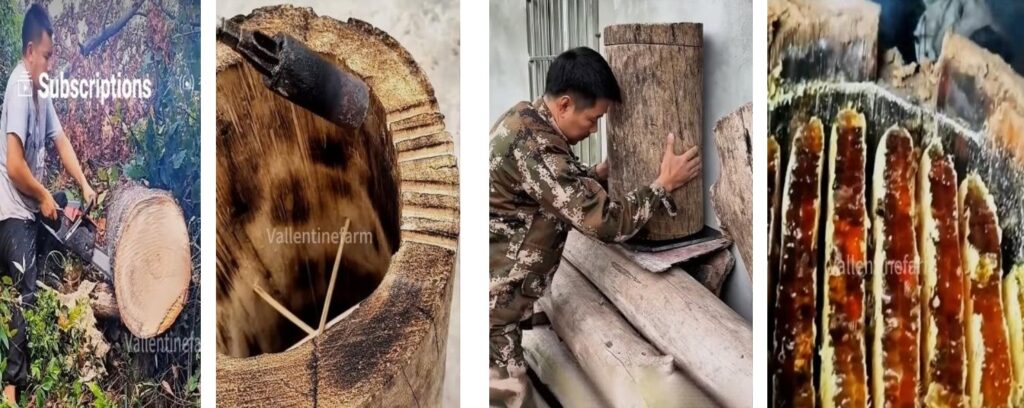
Chinese beekeepers rejuvenating an ancient method of beekeeping (courtesy of 1,2).
Every year, the Co-op is approached to provide educational workshops at summer camps, which we have all contributed to in some way.
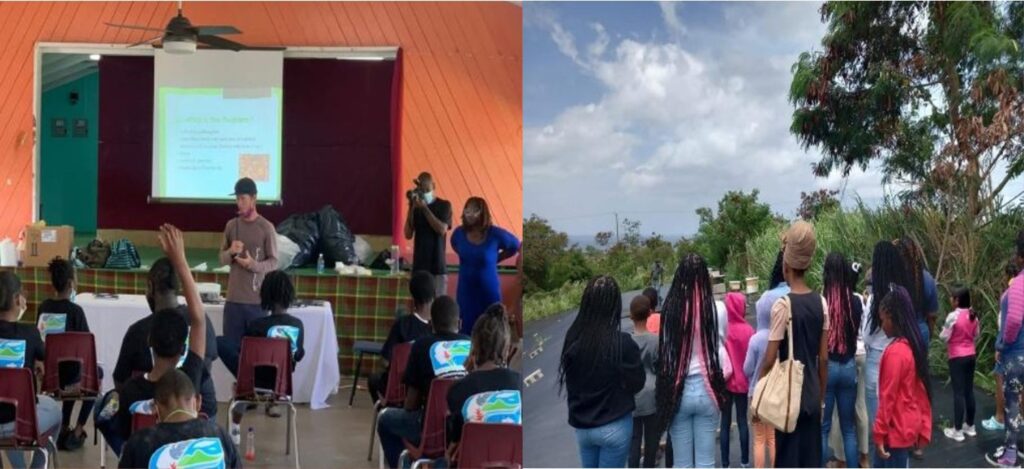
Member Nicholas Dupre leading an educational session (l) and Kennedy ‘Natural’ Hazelle with a group at the national bee nursery.
As the honey farm begins to take shape, we are hoping to increase wider communities’ exposure to the important work of bees as an integral part of ethos. We would love to hear how other beekeeping associations across the Caribbean to attract and sustain young people’s interest to create the next generation of beekeepers.
The St Kitts Beekeepers’ Co-op on a family outing with members of the community.